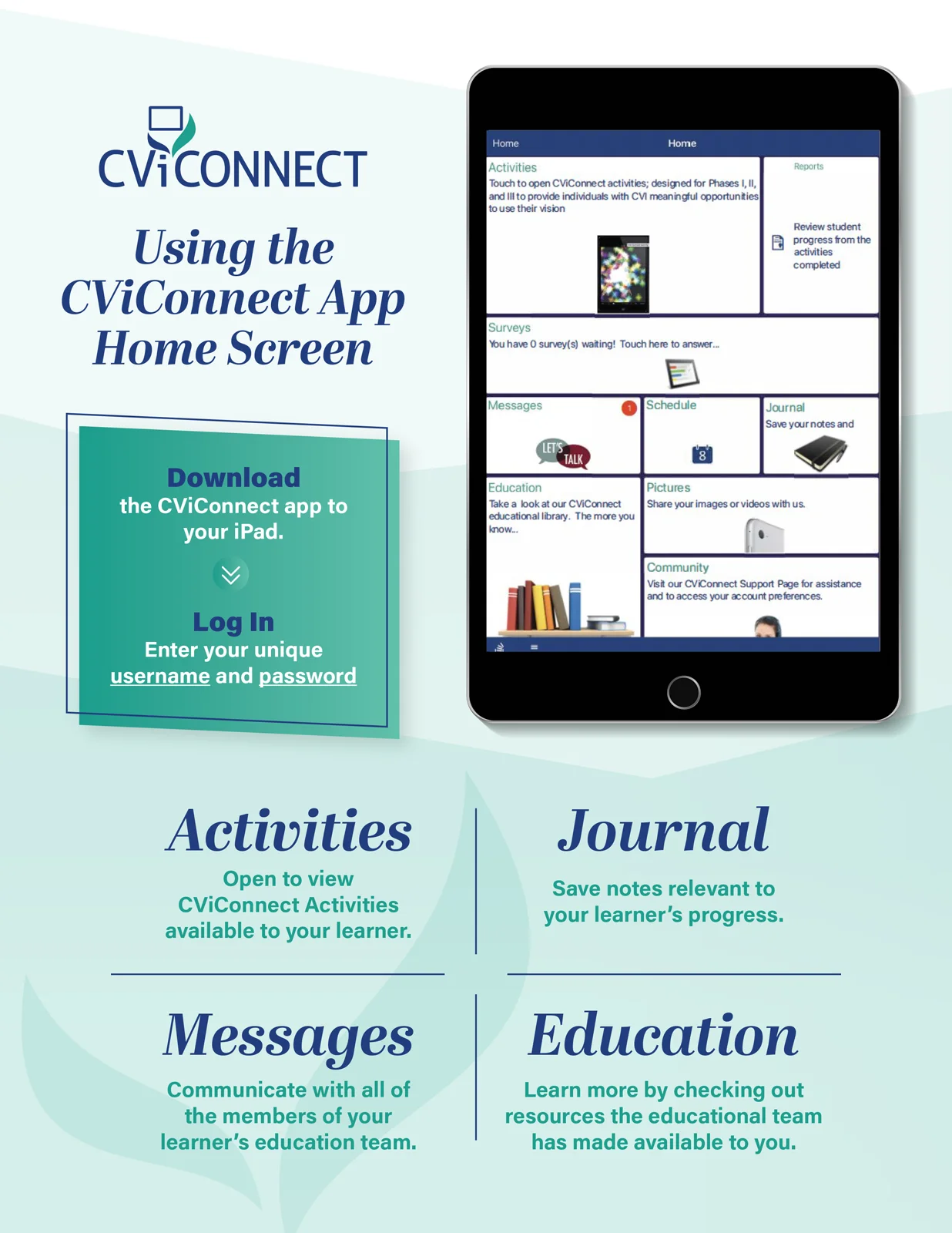

Abstract Introduction: This study investigated a training regimen for teachers of children with visual impairments (TVIs) who need to assess, plan instruction for, and teach students with cortical visual impairment (CVI), as well as the effect of these strategies on the visual behaviors of these students. Method: TVIs learned CVI content knowledge and knowledge of a specific app-based system called CViConnect through a group workshop, seven asynchronous modules, and a year of mentorship from a TVI certified in CVI. When using the CViConnect system on iPads, data are captured during the instructional session, and the looking and touching behaviors of students are automatically saved to a remote server. Results: TVIs with and without specific training used Phase I activities the most, but untrained TVIs used Phase II and III activities more than trained TVIs. Sessions conducted by trained TVIs averaged three times longer than those done by untrained TVIs. Students taught by TVIs without specific training touched items that were not meant to be selected (i.e., sprites and backgrounds) much more than students with trained TVIs, but students taught by trained TVIs looked at the screen more often—M=0.08 looks/s versus M=0.07 looks/s, t(3317)=2.59, p= .005, d=0.09—had longer sustained looks—M=34.08 s versus M=6.67 s, t(3317)=10.11, p < .001, d=0.35—and spent more time looking at the screen than students with untrained TVIs: M =9.51 s versus M=3.21 s, t(3317)=4.12, p < .001, d=0.14. Discussion: Training led TVIs to be able to identify appropriate activities for their students with CVI, thus encouraging the children to use looking behaviors instead of becoming visually overwhelmed and randomly tapping on the screen. Implications for Practitioners: These data seem to show that the training regimen in this project leads TVIs to choose activities of an appropriate level for their students with CVI and to use the CViConnect system to increase looking behaviors in their students